
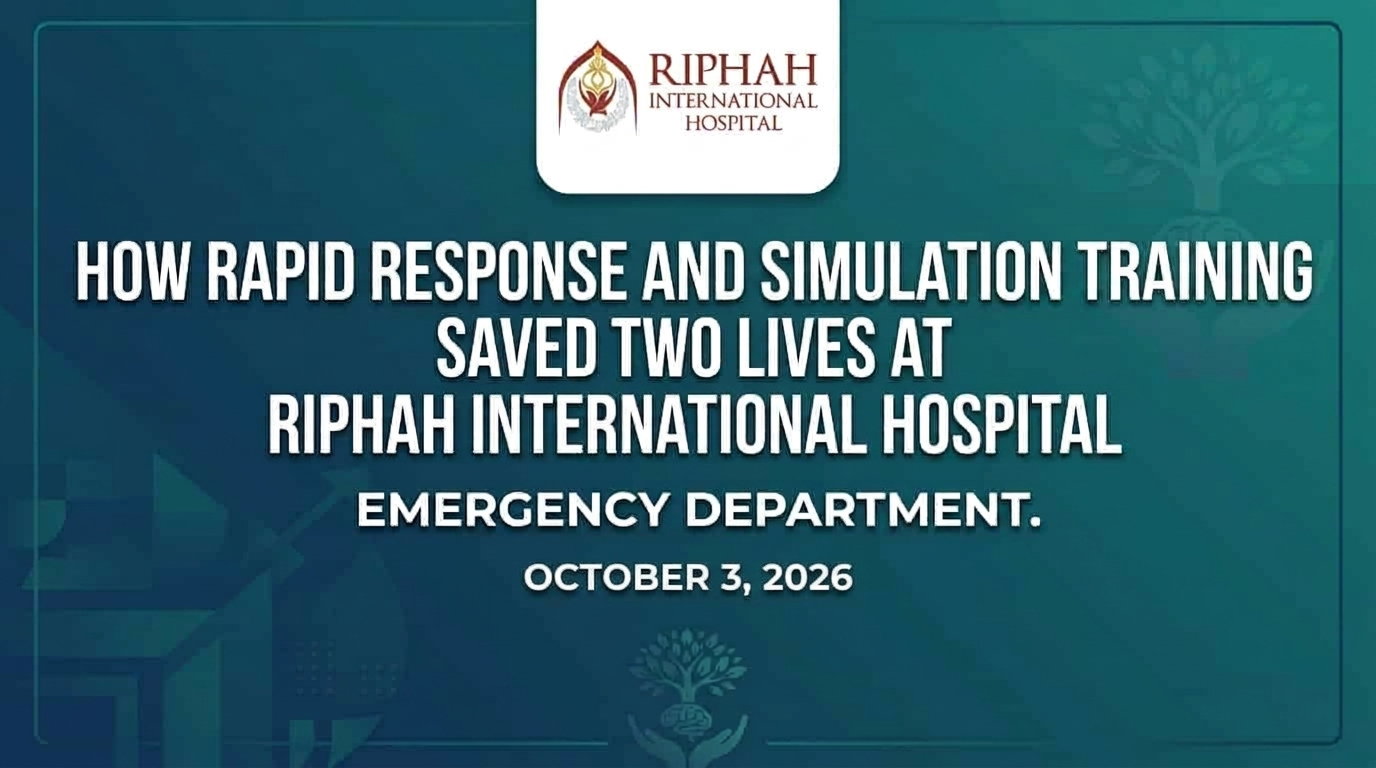
When a 26-year-old expectant mother walked into the Emergency Department at Riphah International Hospital (RIH) on October 3, 2026, no one could have predicted that the next ten minutes would test — and prove — the strength of an entire hospital system.
She was 38 weeks and 4 days pregnant, diagnosed with eclampsia. Moments later, her heart stopped.
What happened next is a story about preparation meeting the moment — and it ended with two lives saved.
A Sudden Cardiorespiratory Arrest in the Emergency Department
The patient had presented with eclampsia, a serious pregnancy complication marked by seizures and dangerously high blood pressure. Within moments of arrival, she suffered a sudden cardiorespiratory arrest — her heart and breathing stopped.
For the Obstetrics and Emergency Medicine teams on duty, this was the kind of emergency every protocol exists to prepare for. And they didn’t hesitate.
Racing Against Time: A Perimortem Caesarean Section in Under Four Minutes
Cardiopulmonary resuscitation (CPR) began immediately. In parallel, the team made a critical, guideline-driven decision: performing a Perimortem Caesarean Section (PMCS) — delivering the baby during ongoing maternal resuscitation to improve the chances of survival for both mother and child.
International emergency obstetric guidelines recommend this be done within four minutes of cardiac arrest when resuscitation efforts aren’t restoring circulation. RIH’s team met that window.
A live male baby was delivered. Ten minutes later, the mother achieved Return of Spontaneous Circulation (ROSC) — her heart started beating on its own again.
Both mother and baby survived. The mother went on to make a complete recovery, and her baby was transferred for specialized neonatal care.
The Difference One Day of Training Made
Here’s the detail that makes this story more than a dramatic emergency — it’s a case study in preparedness.
Just one day before this real emergency, RIH’s teams had conducted a maternal resuscitation and PMCS simulation drill.
When the real event unfolded less than 24 hours later, the response wasn’t improvised. It was rehearsed. Every role, every handoff, every second mattered — and the team had already walked through exactly this scenario.
It’s a powerful, real-world demonstration of what simulation-based training is designed to do: turn high-pressure, split-second decisions into practiced, confident action.
A Multidisciplinary Team Effort
No single department saves a life like this alone. This outcome was the result of coordinated effort across:
- Obstetrics & Gynaecology
- Emergency Medicine
- Intensive Care Unit (ICU)
- Anaesthesia
- Paediatrics
- Nursing Services
- Administration and Support Services
Each team brought its own expertise to a single, unified response — exactly the kind of multidisciplinary collaboration that complex emergencies demand.
What This Means for Patient Safety and Clinical Excellence
This case reinforces a principle that sits at the heart of modern healthcare quality: prepared teams save lives.
The ability to translate training into timely, decisive action during a life-threatening emergency is often the single factor separating a tragic outcome from a complete recovery. This event reflects Riphah’s broader, ongoing commitment to:
- Patient safety and clinical excellence
- Continuous learning and simulation-based emergency preparedness
- Collaboration across departments and across Riphah Healthcare Services as a whole
Congratulations to Every Team Involved
To everyone from Obstetrics & Gynaecology, Emergency Medicine, ICU, Anaesthesia, Paediatrics, Nursing, and Administration and Support Services who was part of this response — thank you. Your swift, skilled, coordinated, and compassionate care reflects the very best of what Riphah stands for.
At Riphah, preparedness becomes action, teamwork becomes strength, and excellence saves lives.
We welcome your feedback and suggestions as we continue to strengthen our systems and raise the standard of patient care.